Sunday, December 30, 2012
Sin in the Second City

Thursday, December 27, 2012
When It Happens to You
Sunday, December 16, 2012
The Buddha in the Attic
Saturday, December 8, 2012
An Object of Beauty
It's a hard book to review because I more or less hated it the entire time I read it. I didn't feel anything for the main character, Lacey Yeager, a driven art dealer. The plot line seemed more or less nonexistent, which doesn't bother me so long as I care about (or at least am interested in) the characters--and in this case, I didn't. Yet I pressed on due to the recommendation and I will say I liked how it ended, enough that I was satisfied that I had read the book. But I can't offer much of a recommendation as the book does a poor job of captivating the reader, unless the reader is someone extremely interested in the New York art scene. I saw the book is being turned into a movie, which is surprising as not too much happens in the book. (Though it is being produced by none other than the author himself, so that might be how that happened.) I suppose though that it might be easier to make the story into a two hour movie than a 300 page book and I'm guessing the movie version will be better.
Sunday, December 2, 2012
Thanking the Monkey

Thursday, November 29, 2012
Let's Pretend This Never Happened
Sunday, November 25, 2012
Swamplandia!
Swamplandia! tells the story of Ava, a young girl who lives in an alligator-wrestling theme park on a small island and her resolve to save the park and her family. She is the youngest of three children and her mother, the park's headliner performer, has died before the novel begins. The park is in despair and her brother Kiwi wants them all to move to the mainland and go to school. When their father disagrees, Kiwi takes off and their father follows shortly after. Ava and her sister Ossie are left behind, but Ossie is wrapped up in an atypical romance and soon Ava finds herself going on a journey to save them all. It is the kind of story that keeps you guessing, not only about what is going to happen, but what is real. It's a very well written, unique novel and I thoroughly enjoyed it. I look forward to reading more of Russell's work.
Wednesday, November 21, 2012
The Third Wheel
That tradition is over now. I hate to say it but I think this series is pretty much dead. The Third Wheel is Jeff Kinney's seventh book in the series and fifty percent of the book seemed like recycled jokes to me. And the way the book began (with Greg reminiscing about his life in utero) was both lame and weird. The end of the book (which unbelievably, I actually did get to) had some funny stuff that was enjoyable, but overall it was not good.
Saturday, November 17, 2012
Blasphemy
Monday, November 12, 2012
autobiography of a blue-eyed devil
Muscio is one sensitive and conscious individual. She is more awake than most of us, aware of underlying racism to which most people turn a blind eye. The book is full of Muscio's personal experiences, but the book isn't much of an autobiography. Instead it is a collection of musings, philosophy, theory, and historical facts. It is difficult to describe, in part because it is such a powerhouse of a book, one that knocked me over. While I was reading it a local woman went missing and there were posters everywhere, headlines about her disappearance were blasted all over the news. My husband asked why such a big deal was being made of her and I rationalized how sad and strange her disappearance was. He said he understood, but that the situation wasn't unique, that a variation of such a story happened all the time. As I read on in the book, it hit me that the tragedy of this missing woman was such a tragedy because she was white and had she been another ethnicity, her face would not be plastered all over town. It's hard to type these words as we like to think race doesn't matter anymore, that we have evolved past all that. But it really runs deep in our society and Muscio sees that, showing the reader the unpleasant truth about (as she calls it) 'Amerikka.' For some it may be a difficult book to swallow, but it's very poignant, forcing the reader to confront America's racist past and present.
Tuesday, November 6, 2012
Macbeth
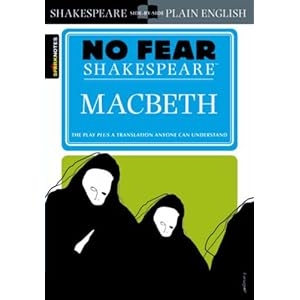 Alan's class spent last month reading Macbeth. I felt like I should read it since I myself never had (which as an English major, writer, and avid reader seemed a bit of an embarrassment). And yet for weeks I just couldn't bring myself to pick up Shakespeare during my leisure reading time, which is so sparse and precious these days. Then I learned I would be subbing in his classroom, which meant that I would have to teach the play. With a sigh, I picked up the play and began to read.
It was, of course, good. I mean, there is a reason these plays are still read, performed, and discussed several hundreds of years later. And yet, I'm not a big fan of reading plays, adding on the additional burden of riffling through the language. But the copy of the book I read was the No Fear Shakespeare, which has the original text with a side by side modern translation, making it more accessible. (No, I'm not afraid or too proud to admit that.) I'm glad I read it and not only because Alan's students asked if I had read it and I could honestly tell them yes, I had. [Last week, in fact.] After combing the text, we watched a film adaptation of the scenes we had just read and the contrast between the enjoyment of watching the play being acted out, as it was intended, and reading the play aloud was stark. I walked away thinking I really should read more Shakespeare (then run out and watch the film adaptations). But I also know it'll be a long, long time before I actually do.
Monday, October 29, 2012
Abandoned: The Book Thief
Sunday, October 21, 2012
Eating Animals
 It's been almost two years since my husband and I agreed our family was going vegetarian. The decision wasn't met with resistance by our sons and though there have been times we've had to fend for ourselves before or after an affair that will serve (meat) food, it's worked out ok. Then this summer we were at a cookout and someone slipped my oldest a brat and he ate it. I tried not to get upset, at least not at my son. He's in middle school now and I believe he needs to make his own choices, even if they will be different than my own values. But I also don't think he can make a decision without the facts. There are plenty of books out there I could have given him, many slanted towards vegetarianism, but I wanted something more objective. I gave him Jonathan Safran Foer's Eating Animals and had him read the first two chapters. He said he found it interesting, then didn't pick it up again, nor did he pronounce he wants to eat meat again. His vague reaction to the book made me pick it up myself again.
Full disclosure: I am in love with this book. I've read it two or three times before this last reading (and it's only a few years old). I will likely continue reading it at least once a year as I don't think I can get enough of it. It's an interesting format--part memoir, part journalism. I hate the title though and worry that people will not pick it up because of the title. (It is supposed to be a play on words-- we not only eat animals, but are animals who eat, but it seems so in your face to me.) There is so much humor and feeling inserted within the pages, along with eye-popping facts and statistics. But the thing I love most is that Safran Foer shows the reader that the issue is not cut and dry and ultimately leaves the reader in the position to decide what is right for her/him. I wish I could force everyone I know to read this book. Since I can't, I'm recommending it as I do think it is one of the most important books I've ever read.
Tuesday, October 16, 2012
Verses
 Around 9/11 this year I was listening to a live album of Ani Difranco and found the hairs on my arms sticking up again over her poem "Self Evident." Then I found a video of Ani reading the poem from her poetry book, Verses. (I highly recommend watching the poem. It is quite long, but truly chilling.) I found a used copy (score!) of Verses and dipped into the poems slowly, until I got towards the end and began a more frantic pacing. In case you don't know about Ani Difranco she is a prolific musician who started her own record label when she was eighteen and has released over 20 albums, many which include a poem. Her song lyrics and poems are amazing and I do feel like she has had more influence on my work than any other writer, even though prior to reading this book I had only heard her recordings, rather than sitting down and reading her words. The book does include many of her songs, which I read an online review that said it was a disappointment to someone looking for new material to see most of the poems in this volume have been recorded in some fashion throughout the years. And yet there is so much power in these poems/ lyrics, so much depth that I appreciated reading them in a more reflective manner than simply listening to them. It's definitely a book I will be returning to again and again.
Tuesday, October 9, 2012
The Plague of Doves
Saturday, October 6, 2012
The Travels of a T-shirt in the Global Economy
 The current selection for my book club is Pietra Rivoli's The Travels of a T-shirt in the Global Economy: An Economist Examines the Markets, Power, and Politics of World Trade. Overall it is an interesting book, though I found large parts to be a bit dry. Rivoli traces the life of a t-shirt, from the cotton farms of Texas to the factories that make the shirts in China to after it is discarded by the American consumer and donated to Salvation Army, only to end up in Tanzania being sold in a market. The book focuses a lot on the policies and politics that drive the present system, which is something that didn't hold my interest. I probably would have appreciated a condensed version that did not go into so much detail about these aspects of the process, though the composite of information does make for an eye-opening look at all that goes into something simple as a cheap t-shirt, an item of clothing I had thought very little of before reading this book. Though I wouldn't recommend this book to everyone, I do think it would be a valuable resource for anyone interested in globalization.
Saturday, September 29, 2012
This Is How You Lose Her
The funny thing was once I started reading, I couldn't remember why I was salivating over it so much. I adored Diaz's novel, The Brief Wondrous Life of Oscar Wao, but had lukewarm feelings about his first short story collection, Drown. I enjoy Diaz's writing and the honesty that accompanies his prose, but sometimes I find the way his characters talk and/or think about women to be very unpalatable, particularly regarding the character of Yunior, who reappears again and again in Diaz's work. My favorite story in this collection is The Cheater's Guide to Love and I liked its (also the book's) final line, a bittersweet ending.
After I set down the book and had time to reconcile my feelings, I realize that my literary side loved it while my feminist side hated it. In the end my opposing feelings toward it balance one another out and I have rather neutral feelings about This is How You Lose Her. It definitely has both virtues and shortcomings, which makes it a delightfully flawed, accessible read.
Monday, September 24, 2012
Revolutionary Road
 The story focuses on the Wheelers, a young suburban couple in the 1950's. The novel opens with the end of a community theater production, one in which April Wheeler starred in, one that was a flop. April and her husband Frank get into an argument after the play and that night changes things for the couple. They both grapple with the state of their marriage, their lives, and what brought them to this point. April soon comes up with a plan to change everything and that is the novel's turning point and what steers the plot to its heartbreaking conclusion.
 I saw there was a movie made a couple years ago based on the novel, but I'm afraid it will taint my memory of this book. I did see the preview and wasn't impressed, so I can't say whether the movie does a good job representing the novel. But the prose is so great--seems so effortlessly simple and clear--that those who saw the film may want to also check out the book. Though I read that nothing else Richard Yates wrote was so well received as Revolutionary Road, I am interested in reading some of his other work as I so thoroughly enjoyed this novel.
Wednesday, September 19, 2012
Breasts: a natural and unnatural history

Thursday, September 13, 2012
NW
 How to convey how excited I was about getting Zadie Smith's new novel? Let me put it this way, Zadie Smith is one of my all time favorite writers, whose last book is one of my favorite books ever (On Beauty) and I've literally waited for the last seven years for her next novel. And here it is--NW.
  NW is the story of four characters who grow up on the same street, but whose lives take them in very different directions. The novel is broken into sections and each has a distinct style that echos the (psychological) place each character is coming from. NW is not a plot-driven story, but an incredible novel about the confusion these characters face. Zadie Smith said in an interview on the Diane Rehm show that when she began writing this novel, she thought about it as a "black Existentialist" novel.
 I love the way Zadie Smith tackles race in her novels. She said in a different interview with NPR about how she only points out a person's race if they are white, flipping the custom of white writers to point out the race of their black characters: "Everybody's neutral unless they're black — then you hear about it: the black man, the black woman, the black person. Of course, if you happen to be black the world doesn't look that way to you. I just wanted to try and create perhaps a sense of alienation and otherness in this person, the white reader, to remind them that they are not neutral to other people."
One review said that the novel was wonderful and brilliant but that the reviewer hated the ending. I disagree. I loved this book--including the ending--and had the rare experience of finishing the book and wanting to immediately start reading it again. I've heard people say books have made them want to do so and have never really felt that before, but this book made me want to go back inside it. I'm looking forward to rereading it again. Zadie did not disappoint.
Friday, September 7, 2012
Grapes of Wrath
You come to really feel for the characters. (I especially worried about Rose of Sharon.) And the prose gives you character description like a whisper, asking the reader to draw her own conclusions, which a lot of contemporary writing has stopped doing. I love how Steinbeck is a master at exhibiting restraint, something I have been trying to learn in my own writing. Overall, The Grapes of Wrath is a beautiful novel, one I am glad I finally got around to reading.
Sunday, September 2, 2012
Several short sentences about writing
Wednesday, August 29, 2012
Nonviolent Communication
The book outlines how to speak compassionately without judgment and to listen with empathy. In other words it's full of lessons we all need. There are a couple things in the book that sound a little cheesy and a times reading some of the conversation role-plays the participants seem to resemble robots, but overall the book is extremely worthwhile and helpful. Having recently finished it, the principles are fresh in my mind and I'm trying to mindful of how I communicate. I hope these ideas stick with me, at least for a while, but I'm sure I'll have to read it again as a reminder.
Saturday, August 25, 2012
All The Pretty Horses
Tuesday, August 21, 2012
Farther Away
He writes about his close friendship with the late writer David Foster Wallace and about how Wallace's suicide effected Franzen. He spoke about his passion for birds and trips to China and the Mediterranean that caused him to reflect on environmental devastations. He discusses books he loves, ones I hadn't heard of but now wish to read (The Man Who Loved Children and Desperate Characters). In "Comma-Then" he complains about the misuse of the word 'then' particularly when used after a comma and in "I Just Called To Say I Love You" he discusses his discomfort with the incessant pronouncements of love over cell phones. This essay delves into 9/11 and the increased usage of the phrase after the tragedy as well as his mother's comfort with uttering the words, but how his father never did. Perhaps my favorite essay was "On Autobiographical Fiction" which tackles the questions Franzen hates to be asked about his novels and reflects on how he became the person he needed to be to write The Corrections. I loved his idea that a writer needs to write the best book he or she possibly can and then to write a second, must become another person entirely so once again can write the best book possible. Though I wasn't crazy about all the essays, overall I really enjoyed this collection and would like to reread some of them again in the future.
Tuesday, August 14, 2012
Wild
The book is about the author's solo journey across the Pacific Crest Trail, a hiking trail that runs from the Mexican border to the Canadian border and is quite difficult. There are trail books hikers sign along the way and Cheryl quickly notices people make the journey in pairs or groups, not alone, surely no women had signed in alone. And yet she continues as it gets increasingly difficult.
Of course the magic of the book is not just about the physical struggle of the trip, but the emotional battleground that she faces. Her mother has died, her marriage has ended, and she is lost. But by facing the challenges of the mighty trail alone, she is able to come to peace with the painful events of her life. It is a beautiful book (which I've heard is being made into a movie) and a worthwhile read.
Friday, August 10, 2012
A Hologram for the King
 I heard a short interview with Dave Eggers on NPR a month ago and put his new novel A Hologram for the King on hold. I was intrigued because he talked about the novel dealing with Schwinn bicycles and how the move to produce parts and labors in China is what killed the company. The Schwinn storyline was minor, simply back story to why this man was where he was. The reader meets businessman Alan when he is in Saudi Arabia, trying to sell a hologram to the king. A lot is riding on this sale, including his home, which is facing foreclosure, and his daughter's college tuition. But the story is about more than just this sale as the trip allows Alan to reflect on his life. It's one of those character-driven literary novels that's thin on plot, the kind I love, but that I realize doesn't have wide appeal. For this reason I can't recommend it, but I did enjoy the quietness of the prose and storyline. I cared about Alan's plight and loved the overarching theme of globalization.
 Tuesday, August 7, 2012
Fifty Shades of Grey

I'm not even sure how to begin this post, the one where I explain my thoughts on a wildly popular erotic novel... Well, perhaps first I should explain why I picked it up: I've heard so much buzz about Fifty Shades of Grey by E L James that I was beyond curious. I put the book on hold back in May but there were so many requests for the novel that I waited over two months, so I pressed on when I began reading and was turned off by the writing and the slow beginning. (One of the things I read about the book [from someone who put it down] was that it should have been called "Fifty Shades of Boring" and I had to agree.) The book is not immediately compelling, but once I continued--largely out of intrigue as to what was behind the hype--I got hooked.
It's funny because I kept thinking "She totally went off the Twilight series for her inspiration" and had a list of similarities, then I read I was mostly right about this as it all started as fan fiction featuring Bella and Edward. (She did a poor job of trying to create new characters, in my opinion. They are thinly veiled versions of Bella and Edward.)
I'm hungry for the next installment, to see what happens with Ana and Christian, but am taking a break for now. I feel the need to read at least a couple quality novels for the sake of balance before even putting the next book on hold. Eventually though, I'll read the whole series.
Wednesday, August 1, 2012
Food Fight
Friday, July 27, 2012
Story Engineering
As someone who writes organically and appreciates the virtues of beautiful prose, I'll admit this book was frustrating to read at times as Brooks advocates for writers to outline and he places higher value on plot than prose. He also gives many examples throughout the book, but tends to use the high drama plots of blockbuster thrillers when I was hungry to hear how that would translate more subtly in a literary novel. Because the thing he did express was that even character driven novels (which I love to both read and write) still need to be engineered, which I did not truly believe until after reading this book. I did walk away from this book loaded with great information about how better to construct a plot and tell a story, so I would recommend it to anyone looking to write novels or screenplays.
Friday, July 20, 2012
The Night Circus
I hesitate to share my hang-ups with the novel, simply because I know I came to it after reading a book on how to read critically. From what I read prior to picking up the novel was that this novel is enormously popular and well liked, so I hate to have my negativity stand in the way of someone picking up a book she/he might love. That said, I wasn't terribly fond of the book. (Yet did finish it, which says something, right?)
Wednesday, July 18, 2012
Reading Like a Writer
I stumbled upon Francine Prose's Reading Like a Writer: A Guide for People Who Love Books and For Those Who Want to Write Them, a book that I'm very glad I found. Obviously I swallow books whole, devouring them with a hunger to meet new characters, new ideas, to learn new things. I read the way I do because I want to learn everything I can about plot and structure so that I can someday craft a novel that can have an impact on someone the way that so many novels have touched me, changed me. But do I read them slow and careful? No, not usually. Yet reading slowly is exactly what Francine Prose prescribes for writers to do.
The virtue of a slow, careful read was a nice reminder to me. There are books that are faster to read than others; some books force the reader to slow down and take it all in. And Prose reminded me of the necessity of a writer reading more of the latter books, which I often tend to take in only sparingly. The book also talked about different aspects of novels--characters, plot, structure, voice--and gave examples that highlighted each. I walked away from this book feeling like I had become both a better writer and reader and highly recommend it to anyone who loves to do either.
Monday, July 16, 2012
Who Walks Among the Trees With Charity
Monday, July 9, 2012
The Newlyweds
Saturday, July 7, 2012
Crank
In my search for looking for good YA novels for Alan's classroom next year, I found a list of books that are popular with seventh and eighth graders. One of the titles was Ellen Hopkins' Crank. I glanced at what it was about--a teen girl on crystal meth. I wasn't sure if the novel would be something that would work for his classroom, but I know that Alan is interested in hearing stories about struggles with addiction, so I placed the book on hold. When it came in, I saw that the book was written entirely in a series of poems, which made me more interested in reading the book myself (though it seemed less appealing to Alan).
It was a quick read and an interesting format. I've seen other novels written with poetry rather than prose and I do enjoy the reading experience, though it can also leave something to be desired--particularly in terms of character development. Some of the things that happen in this book can seem hard to believe simply because you don't know the characters well enough to know if they would actually do these things. Overall I did enjoy the book and found it interesting that it is the first in a trilogy. I plan on eventually picking up the sequel, but am not rushing out to read it.
Subscribe to:
Comments (Atom)